
Florence · Since 1504
David Does Italy
Five hundred years standing perfectly still in Florence. Now I'm finally giving the tour. Come on, I know all the best spots. 😉
Meet DavidTalk to Me
Five hundred years standing perfectly still in Florence. Now I'm finally giving the tour. Come on, I know all the best spots. 😉
Meet DavidTalk to Me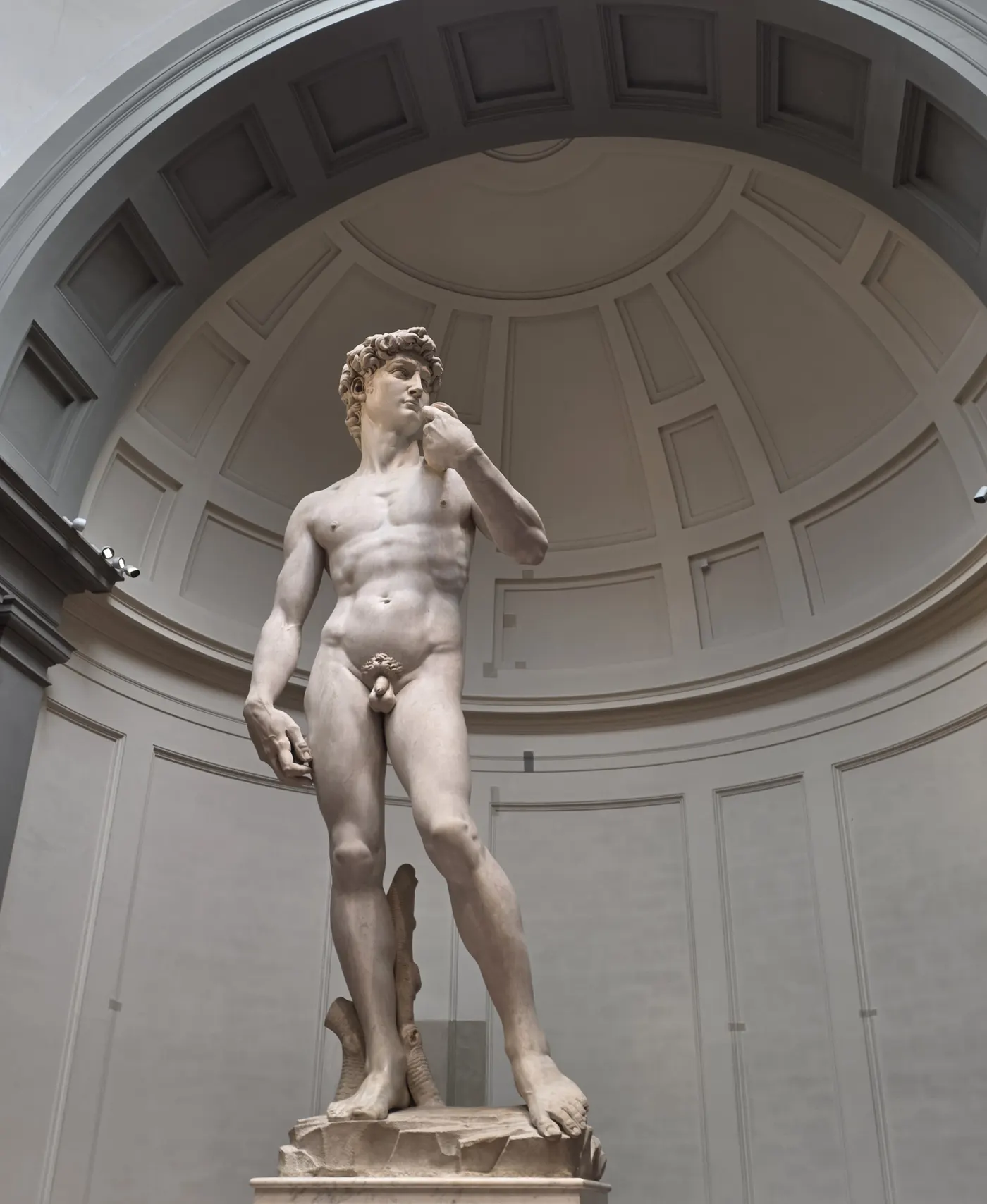
Before he was the most famous statue in the world, David was a problem: a towering, flawed block of Carrara marble that two sculptors had started and abandoned. Florentines called it simply il Gigante, "the Giant." It took a 26-year-old named Michelangelo Buonarroti to see the hero hiding inside.
In 1464 the Opera del Duomo, the board that ran Florence Cathedral, hired the sculptor Agostino di Duccio to make a giant figure to stand high on the cathedral's east end. The following year a huge block was cut at the Fantiscritti quarry near Carrara, in the Apuan Alps, and hauled to Florence. Agostino only roughed it out before stopping, around 1466. In 1476 the job passed to Antonio Rossellino, but his contract soon ended too. The marble was full of small flaws, and it lay exposed to the weather in the cathedral workshop yard for some 25 years.
On 16 August 1501 the cathedral board gave the Giant to Michelangelo, then 26, for 400 ducats. He worked largely in secret behind a screen in the workshop, carving straight into the old, damaged block. By early 1504 the statue was essentially done. Some parts were originally gilded: a garland in his hair, the tree stump behind his right leg, and the sling.
David was meant to join a series of prophets on the cathedral's high buttresses, far above the street. Once Florence saw him, nobody wanted him lost up there. On 25 January 1504 a committee of the city's greatest artists, including Leonardo da Vinci, Sandro Botticelli, Filippino Lippi and Perugino, met to decide where he should go. Florence placed him at the entrance of the Palazzo Vecchio in Piazza della Signoria, the heart of the Republic's government. He was unveiled there on 8 September 1504, a symbol of a small republic standing up to giants.
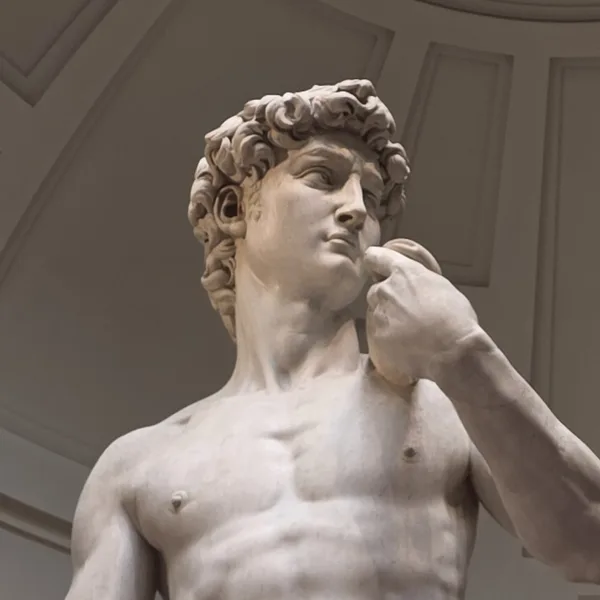
The moment before. Earlier sculptors, like Donatello and Verrocchio, showed David triumphant over Goliath's severed head. Michelangelo chose the tense moment before the fight: the brow is furrowed, the eyes fixed on a distant enemy.
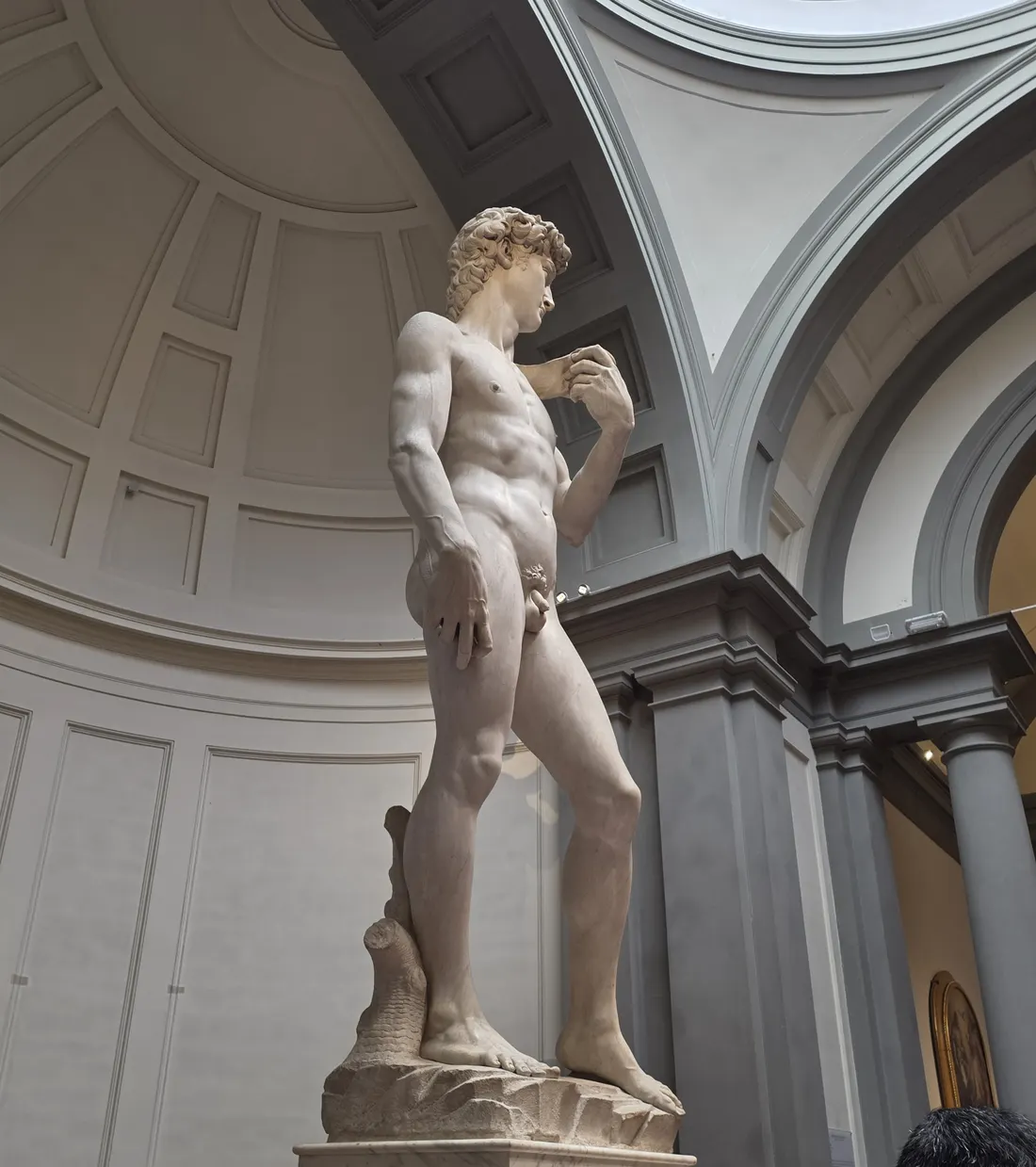
Contrapposto. His weight rests on the right leg while the left leg relaxes forward, so the hips and shoulders tilt in opposite directions. This classical pose makes the marble look relaxed and alive.
The sling. The sling hangs over his left shoulder and down his back, and the stone sits in his right hand. It's easy to miss from the front.
The big hands and head. David's head and right hand are noticeably oversized. Many scholars think this was deliberate, because the statue was planned to be seen from far below. The large hand is also a nod to his nickname manu fortis, "strong of hand."
The gaze toward Rome. Florentines like to say that in Piazza della Signoria, David's watchful glare was turned toward Rome, as a warning to the powerful. It's a much-loved local legend rather than documented fact, but it suits him.
David stands at the end of the Accademia's Hall of the Prisoners, flanked by Michelangelo's unfinished "Prisoners," figures still struggling out of their blocks. They show exactly how he worked: freeing a figure from the stone. Above him, the skylight fills the Tribune with soft daylight, just as De Fabris intended.
Sources include the Galleria dell'Accademia di Firenze, Accademia.org, Florence's official tourism site, and contemporary reporting (UPI 1991; The Guardian 2004 and 2014).
Five centuries on a pedestal gives a fellow plenty of time to think about where he'd go. So here it is: my Florence. The places I came from, the places I lived, and the places where my twins keep watch while I rest my feet.
Before I was me, I was a mountain. My marble came out of the Apuan Alps in 1465, and I spent 25 years lying in a yard waiting for the right sculptor. Worth it.
I was supposed to live way up on the cathedral, one of a row of giant prophets on its buttresses. Brunelleschi's dome is gorgeous, but I'm glad I stayed at eye level.
From 1504 to 1873 I guarded the door of the Palazzo Vecchio. I survived a riot, a lightning bolt and a lot of pigeons. My marble twin stands there now. Wave to him for me.
Climb up across the Arno at sunset and you'll find me in bronze, with the whole city spread out below. Best view in town, and I'd know.
Since 1873 I've lived at Via Ricasoli 58–60 under my very own skylight. Come early, bring a small water bottle, and say ciao.
Siena? Chianti? Venice? Follow along. There's a lot of Italy to see for someone who's been standing still since 1504.
Siena? A gondola in Venice? Pizza in Naples? Tell David where to go, and every week one idea becomes his pick. Think you know him? Try David Trivia.
Ever wanted to ask the world's most famous statue what he's seen? Now you can have a real 2-minute voice conversation with David about his life and his travels in Florence.
David is an AI character, not a real person. You must be 18 or older to use Talk to David.